
|
Previous | SkunkHaven.Net Index | Next |
| Page 1 | Page 2 | Page 3 | Page 4 | Page 5 | Page 6 | Page 7 | Page 8 | Page 9 | Page 10 |
Though there are many different types of cancer, there are five basic categories:
Listed below are some cancers and tumors found in skunks:
I recently had one of my dogs diagnosed with a Mast Cell Tumor (MCT) or Mastocytoma.
I searched for a treament and found Kinavet-CA1® at
http://www.kinavet.com/Information-for-Pet-Owner/About-Mast-Cell-Tumors/
I used this product on the tumor for five days. It worked!
Note: We do not have any information that this product has been used on skunks.
Please consult with your skunk veterinarian whether this product is safe for use on your pet.
Resource links for homeopathic and natural dietary suppliments.
We are giving our skunks Essiac Tea. We buy the box and brew ourselves.
If you pet has growths, cancer, tumors, etc. coming out from the skin.
Your vet can call Buck Mountain Botanicals, Inc.
They have products that can dissolve the growth.
Its cheaper than surgery and radiation treatments.
Read about it here ⇒ http://www.buckmountainbotanicals.net
We hope to someday have EBC-46 in the United States to help our animals and humans too. Scientists have identified a compound in the fruit of the native blushwood shrub that appears to "liquify and destroy cancer with no side-effects", according to latest research.
Read about it ⇒ http://www.qbiotics.com/
Read about it ⇒ http://www.topicalinfo.org/forum/topic.asp?TOPIC_ID=729
MORE suggested items to take to help prevent or fight cancer for both people and pets. We use a lot of the items below on ourselves and our skunks.
NOTE: These are just suggestions. We are not Veterinarians or Doctors.
Always consult your Doctor or Veterinarian.
Do not take all suggestions all at once.
Do your own home work on each item.
* We use Cell Forte MAX with IP-6 & Inositol plus Maitake & Cat's Claw made by Enzymatic Therapy
Inositol is a natural phytochemical (plant chemical) found in rice bran. Several studies since the mid 1980s have shown it to increase Natural Killer (NK) cell activity, thus also exhibiting anti-tumor activity. Studies published in Cancer Letters (1992; 65:9-13) show that Inositol prevents tumors, reduces their size, and is non toxic in both megadoses and long term usage. An article in Carcinogenesis (1995; 16(8):1975-1979) states that "The marker for prostatic cell differentiation, prostate acid phosphatase, was significantly (P < 0.05) increased after 48 h treatment at 0.5-5 mM InsP6. . . . InsP6 [Inositol)] strongly inhibits growth and induces differentiation [often resulting in a reversion to normal cells] in human prostate cancer cells. . . ." We've known about Inositol for some time now, however just recently a supplemental form has hit the market, patented by Dr. A. Shamsuddin, M.D., Ph.D., of the University of Maryland where inositol underwent years of testing. The patented formula is known as Cell Forte with IP-6T and is distributed by Enzymatic Therapy. (Enzymatic Therapy's products are sold by health food stores, food co-ops, physician and chiropractor offices only. If you have trouble locating their products, you may call them at 800. 558.7372 for the store nearest you.) This particular supplement is a unique combination of inositol and inositol hexaphosphate.
There is another form of rice bran found online called RiSoTrieneT. A wonderful antioxidant, this supplement also contains inositol as well as amino acids, lipoic acids, CoQ10, and is also a rich source of vitamin B. Just search for RiSoTriene with any search engine to find a source.
Some facts on Inositol: Inositol is needed for insulin and calcium metabolism, is essential for hair growth, the production of lecithin, growth of cells in the bone marrow, eye membrane and intestines, and aids in the movement of fat from the liver to the body. It also helps to reduce of blood pressure. Caffeine can deplete the body stores of Inositol.
Update: We have recently discovered a number of studies showing Cell Forte with IP-6T is beating chemotherapy. Yes, it is not a 100%, but it is beating any Chemotherapy's statistics in colon, prostate, breast cancers, and a whole lot more. But please, do not run out and begin self medicating; find someone who knows what is going on, a good naturopath, a good nutritionist. Things like this work a lot better when you have a team on your side.
You can research further by reading The Overlooked Cancer Cure From Japan by Bill Sarin
Several authorities have shown that a direct link exists with Helicobacter pylori leading to Hodgkin's Disease and lymphoma. In ferrets they have documented cases of H. pylori and lymphoma. There may be common factors and connections to several types of cancer.
The best interest would be to have young skunks tested for Heicobacter pylori and older skunks tested for Hodgkin's Disease and H. pylori. Skunks with signs of Hodgkin's Disease that pass should on have a necropsy and tested as well.
If we have young skunks tested and can kill the bacteria early then they may not have lymphoma at an older age.
Reference Jackson Siegelbaum Gastroenterology - Helicobacter Pylori for more information on H. pylori.
More information can also be found at Healing Naturally by Bee
Treatment and cures can be found at Earth Clinic and Health Alternative.
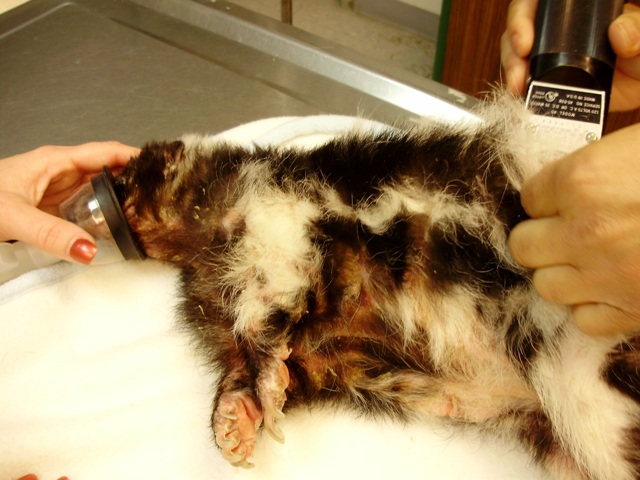
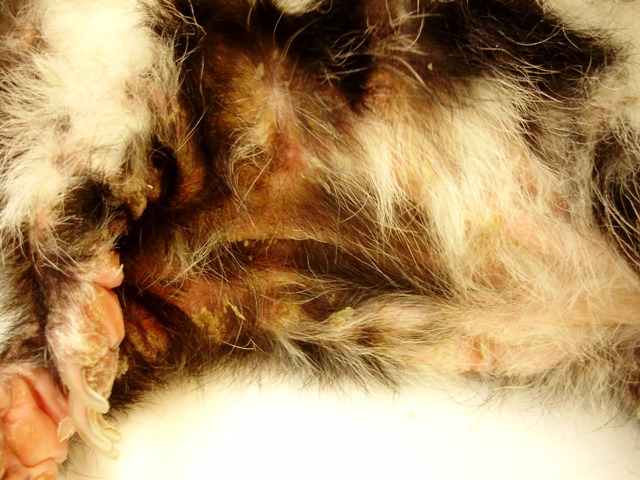
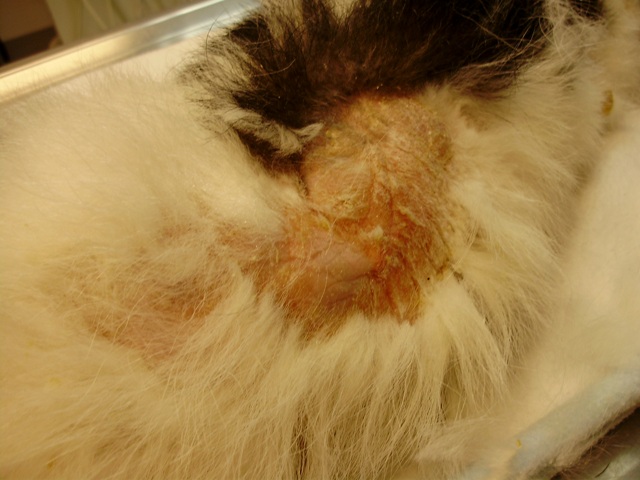
The biopsy stated this could have been and was
more than likely Cutaneous Lymphoma, read about it ⇒
http://ezinearticles.com/?What-is-Cutaneous-Lymphoma?&id=3572140
The other possibilities
were:
Infectious
Dermatopathy OR Immune-Mediated Disease; these could not be ruled
out.
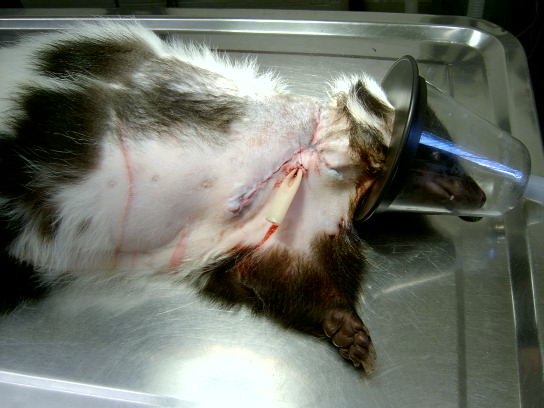
This is a 10 year old that died of Gastric Lymphoma. This consumed the whole stomach. The skunk stopped eating and then started to bleed internally.

|
Read about Primary Gastric Lymphoma and Gastric Lymphoma.
It is best to get a second opinion by a specialist.
We suggest you have your Veterinary send any X-Rays to Veterinary Diagnostic Imaging see https://www.vet-rad.com/
Have your Veterinary call for pricing at 1-888-483-8723 (1-888-4-VETRAD)


Or Email at info@vet-rad.com 
 width=248 height=200>
 |
 width=248 height=200>
 |
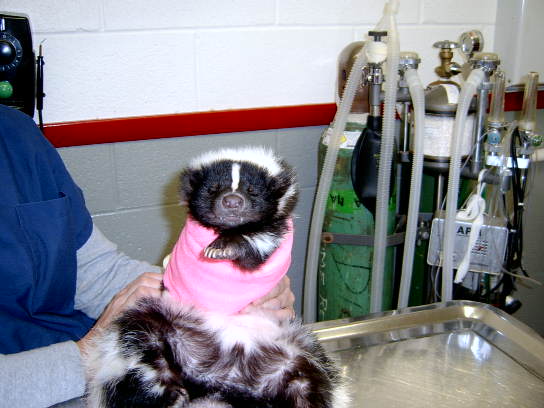
SkunkHaven™ Note: I am happy to say that Sweet Pea is doing good as of 10/04.
 |
|
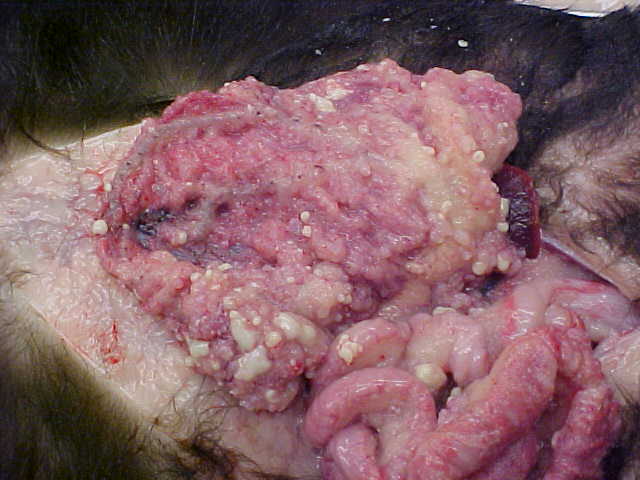
At this time we do not know if the skunk lived in her first home with asbestos or not.
This from EzineArticles, What is Mesothelioma?:
This from National Cancer Institute, Mesothelioma: Questions and Answers:
Are you looking for Mesothelioma Treatment?
Mesothelioma.net provides mesothelioma patients with free resources, support, education, and referrals to experienced mesothelioma doctors.
They are a current sponsor of the American Cancer Society, MD Anderson Cancer Center, Make a Wish Foundation and the National Patient Travel Center.
In addition, they have established a scholarship for high school and college students that will help further educate students of this rare cancer.
For more information go to here⇒ http://mesothelioma.net/
New research on anti-aging looks promising within the next 25 years. Reimagine aging here ⇒ Sens Research Foundation
© 2005-2050 Skunk Haven™ Skunk Rescue, Shelter, and Education, Inc.
Revised 02/25/2024 (SRS)
 | ||
| Previous | SkunkHaven.Net Index | Next |
|
|
Validate HTML 4.01 |